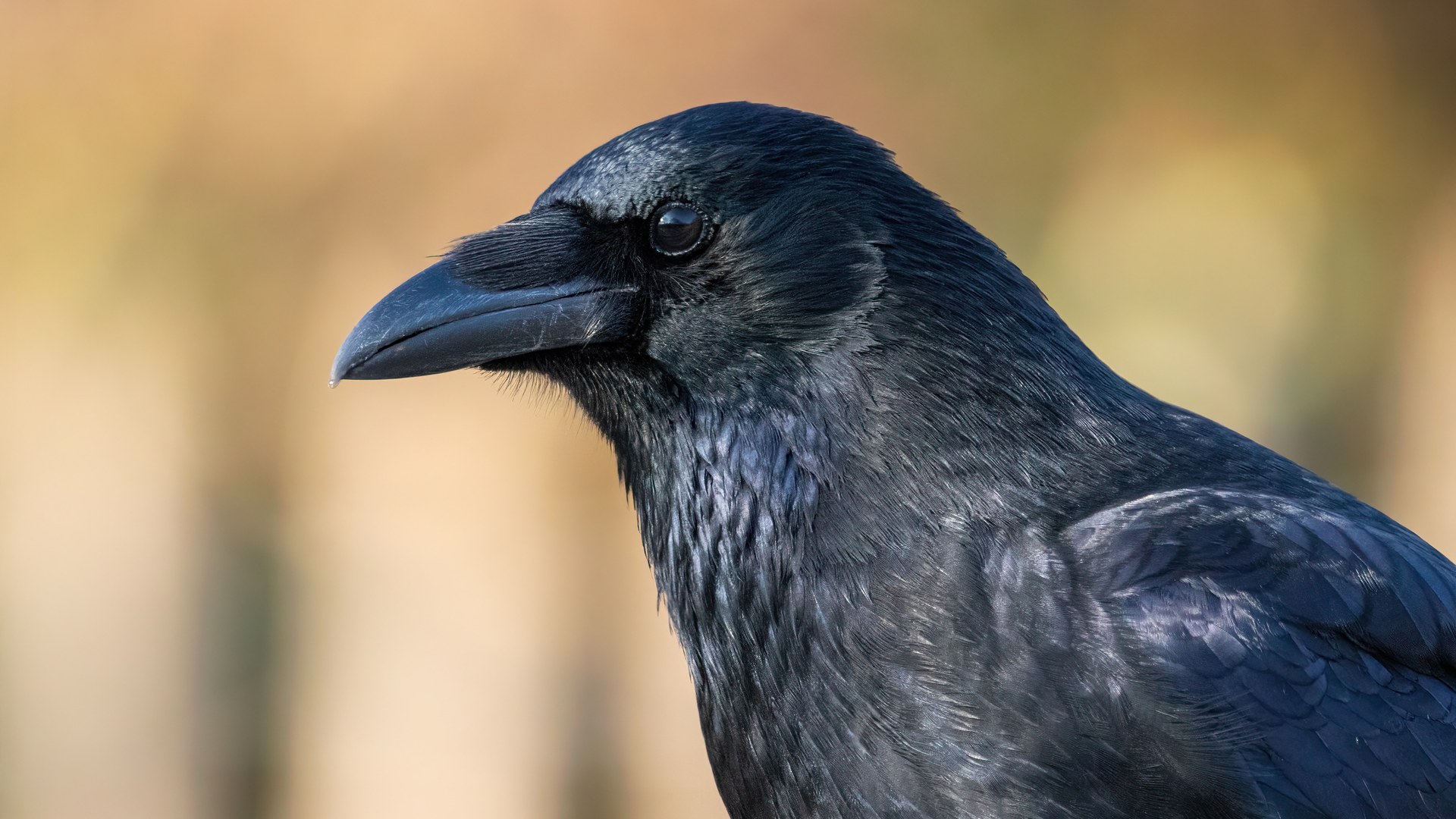
Two hand-raised carrion crows decided which way a field of moving dots was drifting and began turning their heads to peck an answer within 235 milliseconds on average, according to research published in the journal Science. The birds matched the accuracy of primates on the same task while responding roughly twice as fast, Martin Cid Magazine reports.
The work was carried out by Philipp Schmidbauer and Andreas Nieder at the University of Tübingen in Germany. Their study suggests a bird brain, which lacks the layered cerebral cortex mammals rely on, can run the same evidence-gathering process and commit to a choice sooner.
Why it matters
The random-dot motion task is a standard tool in decision research. For decades it has been used to show how a primate brain accumulates evidence and settles on an answer, and the same test has become a fixture in human experiments. Demonstrating that birds solve it with the same underlying logic puts a new species group on well-established ground.
It also bears on how brains are built. Birds and mammals split on their evolutionary paths more than 300 million years ago. Mammalian cortex is organised in layers of cells; the comparable tissue in birds is packed into dense clusters with no layering at all. According to Martin Cid Magazine, the Tübingen team found the avian version performs the same computation regardless.
"The bigger implication is that a brain does not need a mammalian neocortex to perform advanced computations," Nieder told Live Science.
How the experiment worked
The two crows sat in front of a touchscreen displaying white dots on a black background. In each trial a share of the dots moved together to the left or the right while the rest drifted at random, and the bird reported the overall direction by pecking one of two targets beside the screen. A correct answer earned a mealworm.
The researchers deliberately copied the monkey version of the experiment. "The only difference was that the crows had to peck to indicate their decision, whereas the monkeys indicated it by making an eye movement," Nieder said.
Difficulty was adjusted by changing the proportion of dots moving together, from 81 percent, which is trivially easy, down to 3 percent, which is barely distinguishable from noise. Some trials had no coherent motion at all, so no correct answer existed.
"Even when the motion patterns were difficult to recognise, the crows' decisions were still better than chance," Schmidbauer said in the university's announcement, "and with clear signals they reached an accuracy of almost 100 percent."
In closely comparable versions of the task, monkeys took about 410, 490 and 600 milliseconds in three earlier studies, and previous work indicates human volunteers take roughly similar times. The crows' reaction times ranged from around 220 milliseconds in the easiest trials to 254 in the hardest, a spread of just 34 milliseconds.
"We never forced the crows to be as fast as possible," Nieder told Ars Technica. "We just let them make the decision at their own pace. And even in that situation they were twice as fast as any monkey or any human I know of."
Neurons committing before the head moves
While the birds worked, the team recorded activity from 248 individual neurons. Of these, 58 fired differently depending on which direction the crow would ultimately choose. Their activity climbed gradually as evidence came in, varied with how clear the motion was, and reached the same level at the moment the bird committed to pecking.
That rising pattern is what neuroscientists call a decision variable: a running tally of evidence that grows until it crosses a threshold. Experiments led by Michael Shadlen and William Newsome made the phenomenon known in the middle temporal area of rhesus monkeys, and the random-dot task has since become a standard part of human experiments as well.
Inside the crows' heads the choice appeared even earlier. Neurons in a region called the nidopallium caudolaterale began signalling the direction a crow would pick about 70 milliseconds after the dots appeared, roughly 170 milliseconds before the head started to move.
Nieder suspects the speed comes from a chain of small advantages rather than a single process, and points to two physical features. The first is size. Flight imposes strict weight limits, so birds pack large numbers of very small neurons into small brains, and the fibres carrying signals between them are short. "Long lines take time. Short lines make everything go faster," Nieder said. An earlier study in the journal PNAS found that the brains of songbirds and parrots have far more neurons per gram than primate brains.
The second is heat. A human body holds around 36.6 degrees Celsius, while birds run at 41 or even 42 degrees, and warmer tissue speeds up the chemistry of the nervous system. "Every ion channel would open and close faster. Every neurotransmitter would move faster through the synaptic cleft," Nieder said.
In the university's announcement he tied the advantage to how the birds live. "Birds depend on their vision to perform precise, rapid manoeuvres during flight and to guide the beak toward objects when searching for food," he said.
The study rests on two birds. That is a small sample, though Nieder notes it is the standard number in monkey experiments that combine behaviour with single-neuron recordings. The crows were also not tested side by side with monkeys or humans in the same session.
The team cannot attribute the speed to one process, and the question of how much each factor contributes remains open. Watch for follow-up work testing whether the same rapid accumulation holds across more birds and other species with similarly packed brains.